A scene from one of my all time favorite movies, Man On Fire.
Excellent use of diegetic and non diegetic sounds, camera angles and what I think is a higher shutter speed for a staccato effect.
It's edited incredibly fast and often displays a rolling shutter lag which emphasizes the confusion that Denzel Washington's character is feeling. There is a mix of high and low angle shots which emphasise there is a pending struggle for power.
The sharp noise mixes well with the changing edit. A nice piece of work by Christian Wagner.
Wednesday, 12 January 2011

Friday, 7 January 2011
City of Chicken
City of God chicken chase opening.
Brilliantly juxtaposition of the humorous chicken race against the backdrop of the slum and the fact its occupants are just as willing to kill each other as they are chicken.

Brilliantly juxtaposition of the humorous chicken race against the backdrop of the slum and the fact its occupants are just as willing to kill each other as they are chicken.

Wednesday, 5 January 2011
Raging Bulls
Brilliantly edited scene which probably won the Oscar for Thelma Schoonmaker.
"You never got me down, Ray"
Excellent mix of slow and fast cutting coupled with brutal shost of the consequences of Sugar Ray's relentless pounding (blood splatters on the knees and commentators).
"You never got me down, Ray"
Excellent mix of slow and fast cutting coupled with brutal shost of the consequences of Sugar Ray's relentless pounding (blood splatters on the knees and commentators).
Monday, 3 January 2011
How soup changed cinema forever!
The Kuleshov experiment:
Kuleshov edited together a short film in which a shot of the expressionless face of a Tsarist actor was alternated with various other shots: a plate of soup, a girl, a little girl's coffin.
The film was shown to an audience who believed that the expression on the actor's face was different each time he appeared, depending on whether he was "looking at" the plate of soup, the girl, or the coffin, showing an expression of hunger, desire or grief respectively. Actually the footage of Mozzhukhin was the same shot repeated over and over again. Vsevolod Pudovkin (who later claimed to have been the co-creator of the experiment) described in 1929 how the audience "raved about the acting.... the heavy pensiveness of his mood over the forgotten soup, were touched and moved by the deep sorrow with which he looked on the dead child, and noted the lust with which he observed the woman. But we knew that in all three cases the face was exactly the same."
The Russians knew the importance of montage and film editing and this is a very early example of how film was edited in such a way to convey emotion.
Friday, 31 December 2010
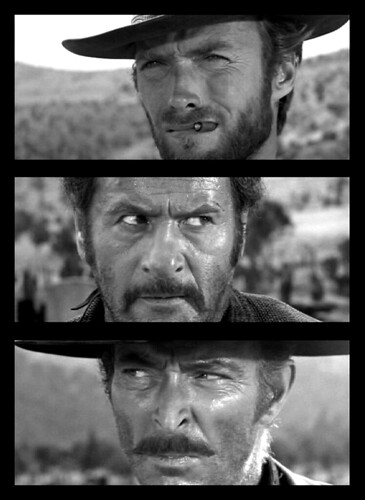
Good Bad Ugly
Classic editing on The Good, the Bad and the Ugly.
Long takes on the eyes & body parts, rousing music, the whole shebang.
The scene lasts just under 5 minutes from Clint Eastwood's character approaching his mark to him finally firing his gun. 5 minutes of character silence, with only the classic theme for company.

Long takes on the eyes & body parts, rousing music, the whole shebang.
The scene lasts just under 5 minutes from Clint Eastwood's character approaching his mark to him finally firing his gun. 5 minutes of character silence, with only the classic theme for company.
Wednesday, 29 December 2010
Stay off the set!
We might not often see the editor on set. Maybe this is because the Director doesn't like them, or because there's very little reason for them to be there. It may be a mix of things, but now I understand that perhaps the biggest reason is because an editor does not want to see the film being filmed.
An editor's job at it's most basic is to match the shots in an understandable way so that an audience can view them coherently. An editor does not want to see actors out of costume, things on set that weren't in the frame etc. This is because this is what an audience sees and an editor wants to deliver the best possible vision to an audience without the distraction of what he has seen on set be play a part.
Tuesday, 28 December 2010
Famous cuts
Hailed as the greatest cut in movie history, the bone turning to the space satellite/warhead is an example of a match cut.
2001: A Space Odyseey

Equally lauded by filmmakers is this exquisite cut from Lawrence of Arabia.

Apocalypse Now showcasing a huge contrast between war and peace.

A great and perhaps one of the earliest examples of a 'jump cut' in Jean-Luc Godard's Breathless.

A quality example of a process called slow cutting from Clockwork Orange. Slow cutting is a process which uses shots which last for long durations.

2001: A Space Odyseey

Equally lauded by filmmakers is this exquisite cut from Lawrence of Arabia.

Apocalypse Now showcasing a huge contrast between war and peace.

A great and perhaps one of the earliest examples of a 'jump cut' in Jean-Luc Godard's Breathless.

A quality example of a process called slow cutting from Clockwork Orange. Slow cutting is a process which uses shots which last for long durations.

Subscribe to:
Posts (Atom)